



WIOA Billable Time Guidelines
Accurate Time Tracking Protects Your Funding
Incorrect time classification creates audit risk and funding jeopardy. Learn what staff time can be charged to grants and how validated tracking protects awards.
Understanding WIOA Billable Time
Uniform Guidance and WIOA cost principles define how time must be classified, documented, and allocated.
Direct Program Time
Fully billable activities that directly support participant outcomes.
Administrative Time
Billable time that must remain within the 10% administrative cap.
Non-Billable Time
Activities that cannot be charged to WIOA or Department of Labor grants.
Governing Rules and Regulations
Key regulatory frameworks that define WIOA billable time requirements.
Primary Regulations
- 2 CFR Part 200 (Uniform Guidance)
Defines allowable costs, cost allocation, and documentation requirements for federal grants.
- 20 CFR 683.215
Distinguishes administrative vs program costs for WIOA Title I.
- 20 CFR 618.860
Trade Adjustment Assistance fiscal requirements.
Guidance Documents
- TEGL 2-07
Clarifies WIOA cost classification.
- TEGL 14-18
Aligns performance accountability with allowable costs.
- 2 CFR Part 2900
DOL-specific grant requirements.
Billable Time Categories
How WIOA and workforce grants classify staff time and activities.
A. Direct Program Time (Fully Billable)
Activities that directly support participant outcomes.
- Case management & eligibility determination
- Developing Individual Employment Plans
- Career services & job placement
- Training coordination (OJT, apprenticeship)
- Supportive service coordination
- Employer engagement for placements
- Tracking skill gains & credentials
B. Administrative Time (Capped at 10%)
These activities must be tracked within the 10% administrative cost cap.
- Accounting, budgeting, payroll
- Procurement & property management
- Audit resolution & monitoring
- General legal services
- Policy development
- Centralized IT & HR support
C. Non-Billable / Unallowable
These activities cannot be charged to WIOA or DOL grants.
- Lobbying & political activity
- Fundraising activities
- Entertainment & alcohol
- Fines & penalties
- Supplanting state/local funds
- Cross-funding without allocation
WIOA Billable Time Task Matrix
Quick reference for common workforce activities and audit classification.
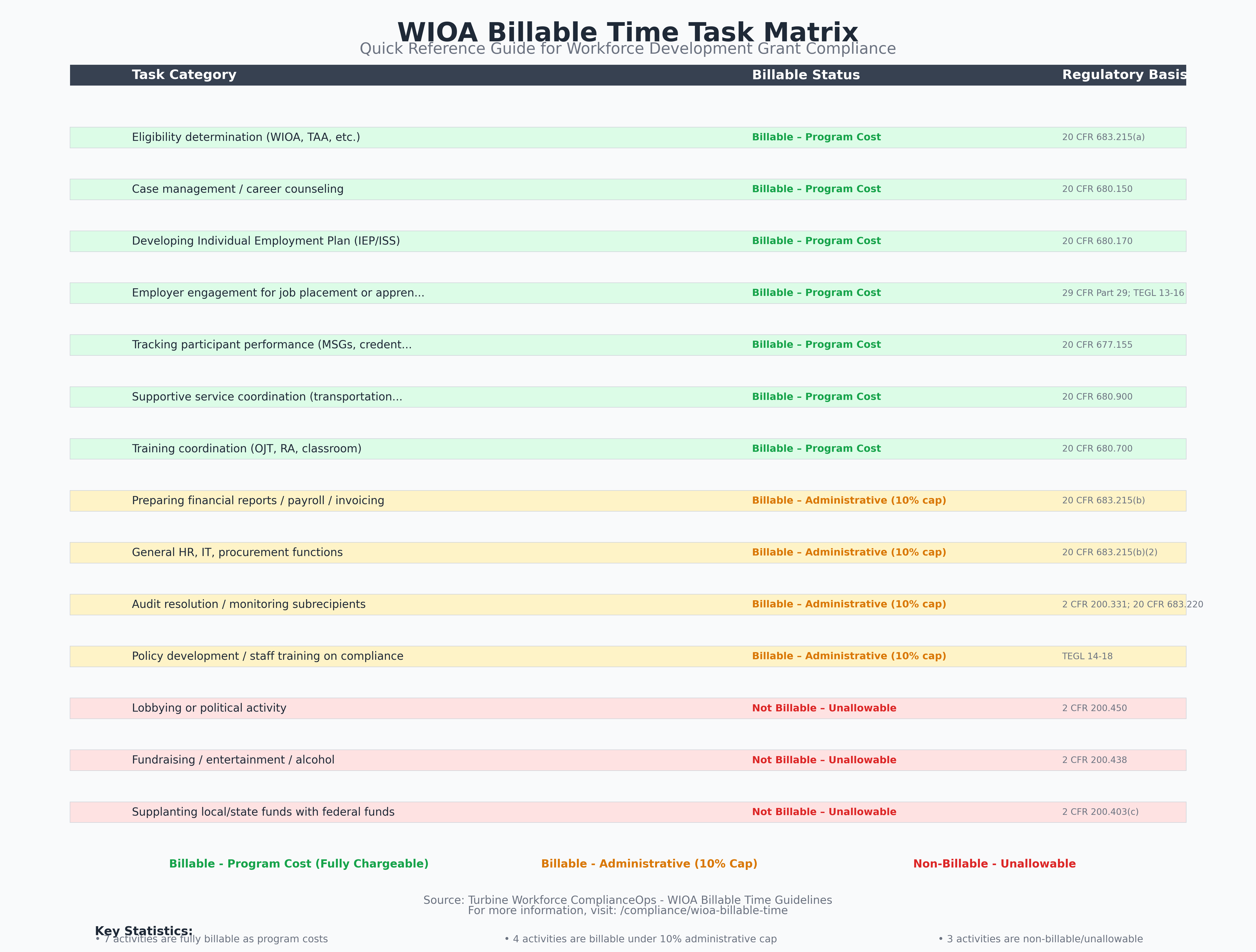
| Task Category | Billable Status | Regulatory Basis |
|---|---|---|
| Eligibility determination (WIOA, TAA, etc.) | Billable – Program Cost | 20 CFR 683.215(a) |
| Case management / career counseling | Billable – Program Cost | 20 CFR 680.150 |
| Developing Individual Employment Plan (IEP/ISS) | Billable – Program Cost | 20 CFR 680.170 |
| Employer engagement for job placement or apprenticeship | Billable – Program Cost | 29 CFR Part 29; TEGL 13-16 |
| Tracking participant performance (MSGs, credentials) | Billable – Program Cost | 20 CFR 677.155 |
| Supportive service coordination (transportation, childcare) | Billable – Program Cost | 20 CFR 680.900 |
| Training coordination (OJT, RA, classroom) | Billable – Program Cost | 20 CFR 680.700 |
| Preparing financial reports / payroll / invoicing | Billable – Administrative (10% cap) | 20 CFR 683.215(b) |
| General HR, IT, procurement functions | Billable – Administrative (10% cap) | 20 CFR 683.215(b)(2) |
| Audit resolution / monitoring subrecipients | Billable – Administrative (10% cap) | 2 CFR 200.331; 20 CFR 683.220 |
| Policy development / staff training on compliance | Billable – Administrative (10% cap) | TEGL 14-18 |
| Lobbying or political activity | Not Billable – Unallowable | 2 CFR 200.450 |
| Fundraising / entertainment / alcohol | Not Billable – Unallowable | 2 CFR 200.438 |
| Supplanting local/state funds with federal funds | Not Billable – Unallowable | 2 CFR 200.403(c) |
Documentation Requirements
Essential records to charge staff time to WIOA or DOL funding.
Time & Effort Certifications
Signed by employees or supervisors, documenting actual time spent on allowable grant activities.
Cost Allocation Plans
Required when time is split across WIOA, TANF, SNAP E&T, or other funding sources to ensure proper distribution.
Activity Linkage Records
Evidence that hours are tied to allowable activities and participant outcomes such as MSGs or credentials.
Validated Time Tracking with Apprentage
How Apprentage helps reporting teams capture accurate time data, maintain audit-ready documentation, and protect funding.
Data Validation and Reporting Accuracy
Validation at Entry
Required fields and classification rules enforced when time is logged—not at quarter-end.
Source Documentation
Every time record links to activity evidence, timestamps, and supervisor verification.
Error Flagging
Misclassification and missing fields flagged before they reach submissions.
Audit-Ready Exports
Generate time-and-effort reports with complete documentation chain for monitoring and review.
Key Benefits
Ready to Reduce Time Tracking Errors?
See how Apprentage validates time data at entry, maintains audit-ready documentation, and protects your funding through accurate reporting.