



For Registered Apprenticeship Sponsors
This case study explains how GACC PIT transformed its Registered Apprenticeship documentation process using VELA to capture, verify, and structure On-the-Job Training (OJT) data in real time. With transparent recordkeeping—every step tracked and visible to apprentices, supervisors, and program administrators—VELA automates task-level records with supervisor validation and competency mapping. As a result, the sponsor achieved fully audit-ready documentation aligned with common DOL review expectations, increased transparency for stakeholders, supported RAPIDS reporting, and delivered measurable, data-driven ROI for employers.
For Employers
VELA gives you real-time visibility into what your apprentices are learning—without adding paperwork to your supervisors' day. Apprentices log OJT by voice or mobile at the point of work; supervisors approve individual records in minutes, not hours. You get structured evidence of your training investment: task-level documentation, competency progress tracking, and audit-ready records that prove ROI to leadership and satisfy sponsor reporting requirements.
Data source: Usage from 2023 through December 2025 across 143 active apprentices and 7 occupation pathways, totaling 18,984 supervisor-validated OJT records.
This case study is written for apprenticeship sponsors, reviewers, and operators who need to verify—not just understand—how OJT documentation holds up under scrutiny.
5 min: Problem → Results → Bottom Line
Compliance: How It Works → Sample Records → DOL Alignment
ROI: Baseline → Results → Admin Burden

VELA is a voice-enabled OJT documentation system that captures on-the-job training at the point of work, automatically maps tasks to Work Process Schedule competencies, and routes records to supervisors for individual validation. It transforms paper logbooks into structured, audit-ready evidence that meets DOL requirements and provides the data foundation for employer ROI calculations.
See How It Works
2-minute overview: How apprentices capture OJT and supervisors approve it
⸻
⚙️ The Problem Every Sponsor Knows
If you operate a Registered Apprenticeship program, you've likely faced some or all of these challenges:
OJT documentation that doesn't hold up.
Apprentices fill out logbooks from memory—sometimes days or weeks later. Supervisors sign stacks of entries without reviewing individual tasks. When DOL or your State Apprenticeship Agency asks for competency evidence, you're not providing records—you're recreating them.
Work Process Schedules that exist on paper only.
You registered Standards with detailed WPS competencies and target hours, but day-to-day, there's no structured method to track balanced skill progression. Reports show cumulative time, not competency coverage.
Supervisor sign-off that lacks verification.
A weekly signature doesn't demonstrate observed, validated work. DOL reviewers differentiate between administrative approval and verified supervision—and paper systems can't.
No real-time visibility into progress.
Without digital records, sponsors can't see how apprentices are actually developing. Some may repeat the same tasks for months or miss exposure to critical competencies entirely. By the time it's visible, retraining opportunities are gone.
Competency tracking that overwhelms staff.
Manually mapping OJT tasks to 50, 100, or 200+ competencies consumes hours of staff time and produces inconsistent data. It's administrative work that adds no value to the learning process.
Audit preparation that drains resources.
When a monitoring visit or DOL review approaches, staff scramble to reconcile hours, fill gaps, and chase missing signatures. It's reactive compliance instead of proactive oversight.
No data foundation for employer ROI.
Perhaps the most critical gap: without structured, validated OJT data, sponsors have no empirical basis to demonstrate the apprenticeship's value to employers. They can't quantify productivity gains, skill attainment speed, or retention impact—metrics central to employer ROI and the justification for continued participation. When documentation lives on paper, ROI lives on anecdotes.
The real risk: documentation gaps become compliance and credibility gaps.
Incomplete OJT records lead to findings. Findings lead to Corrective Action Plans. Persistent noncompliance can jeopardize program registration—and erode employer trust. Without verifiable data, sponsors are exposed on both fronts: compliance and value.
⸻
What GACC PIT Changed
GACC PIT is an intermediary sponsor operating manufacturing apprenticeship programs across Western Pennsylvania—143 active apprentices at multiple employer sites, seven occupation pathways from Mechatronics Technician to EV Automotive Technician.
They faced the same documentation problems every sponsor faces, at a scale that made manual workarounds impossible.
Before-VELA estimates based on sponsor interviews and industry benchmarks for similar program sizes.
Their solution: Replace after-the-fact logbooks with a system that captures OJT as work happens, routes it to supervisors for same-day approval, and maps every entry directly to Work Process Schedule competencies.
Continuous OJT Evidence: How It Works
What Apprentices Do
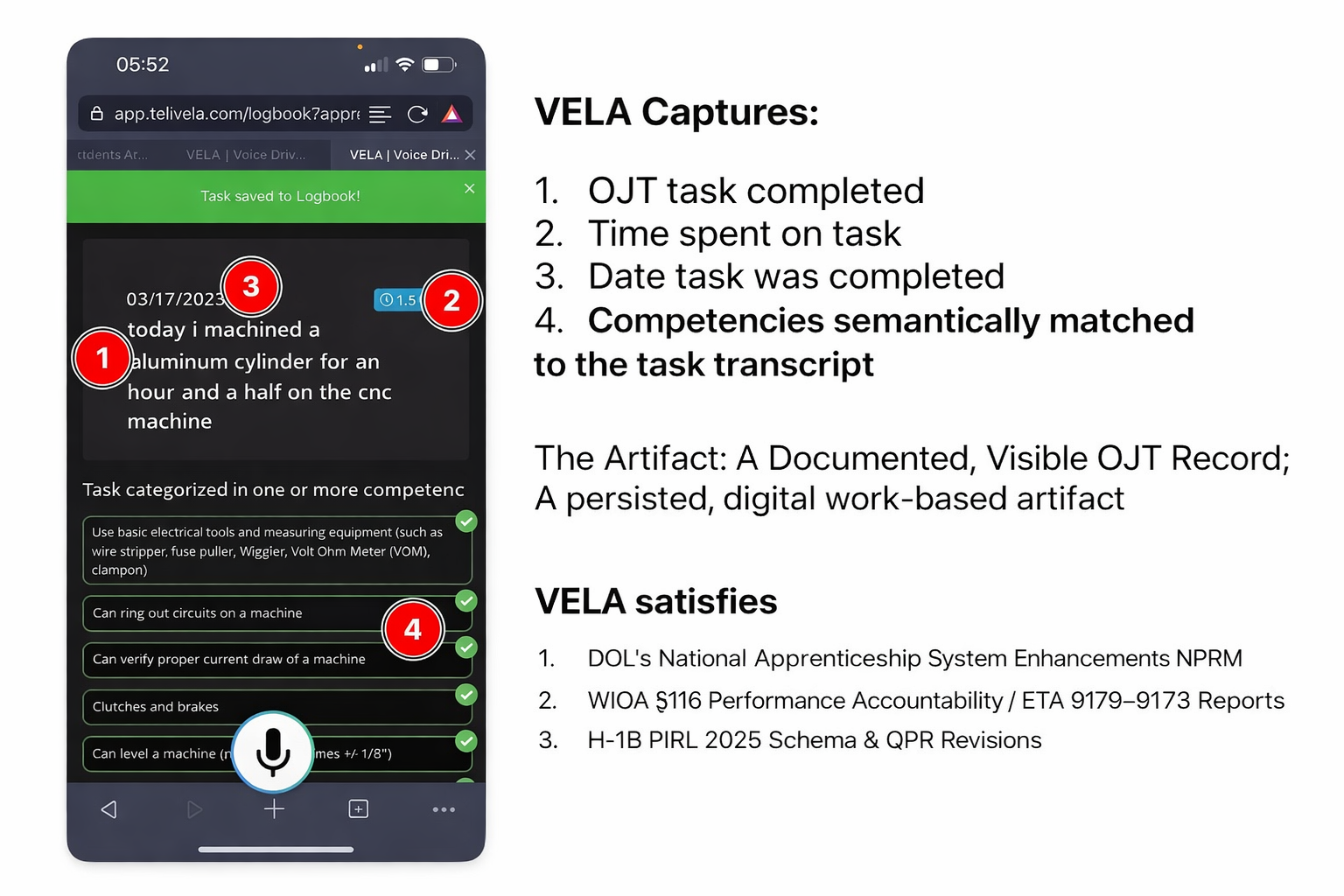
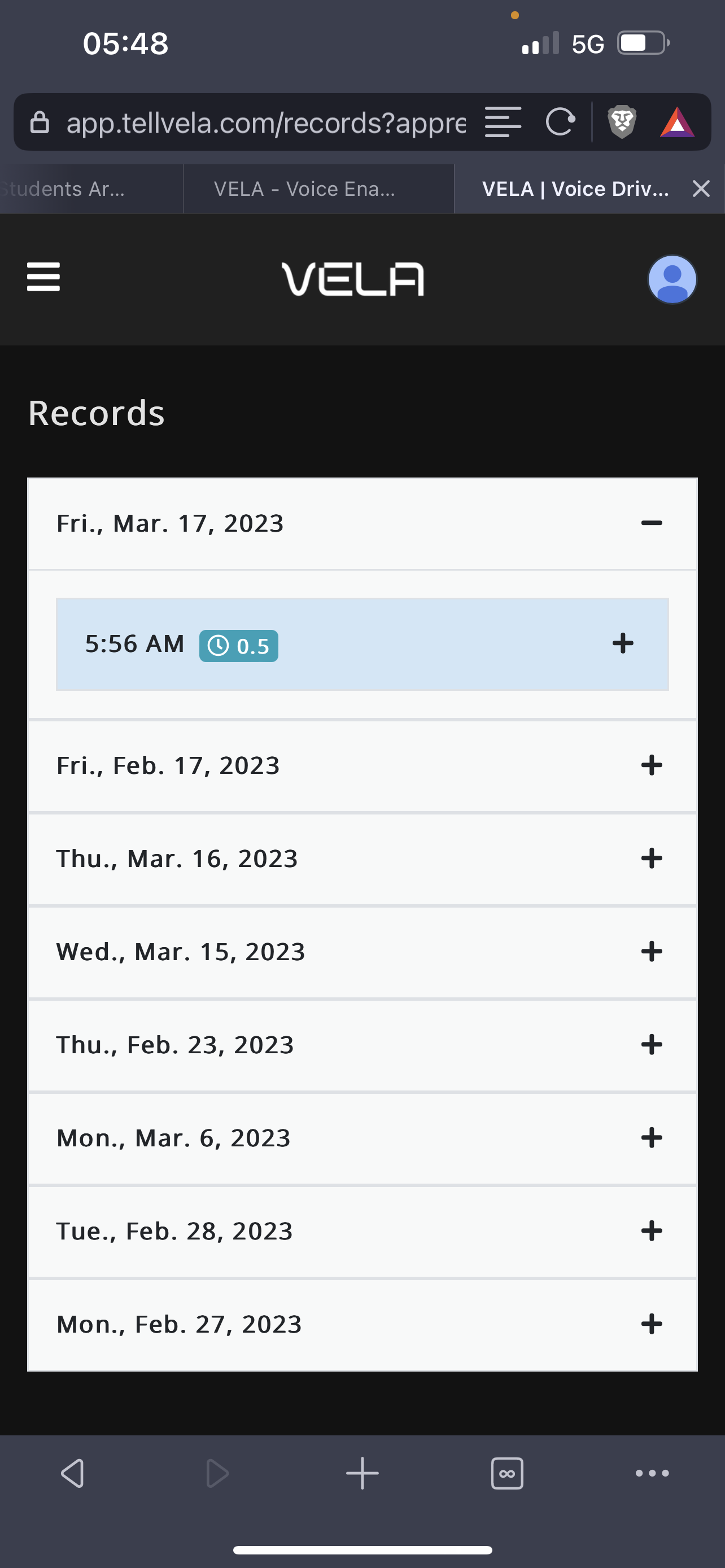
Apprentices capture OJT at the end of a task or shift using voice or mobile entry. They describe what they did—in their own words, on the shop floor. Example: "Replaced hydraulic cylinder seal on press #3. Tested to 2500 psi. Back in production."
They don't fill out forms. They don't wait until Friday. They talk about the work while it's fresh.
What VELA Does
VELA transcribes the entry, extracts hours, and maps the work to your registered Work Process Schedule competencies. A hydraulic repair gets tagged to "Hydraulic Systems" and "Preventive Maintenance." An electrical troubleshoot gets tagged to "PLC Troubleshooting" and "Sensor Diagnostics."
This mapping happens automatically, based on your program's WPS definitions. No manual coding required.
What Supervisors Do
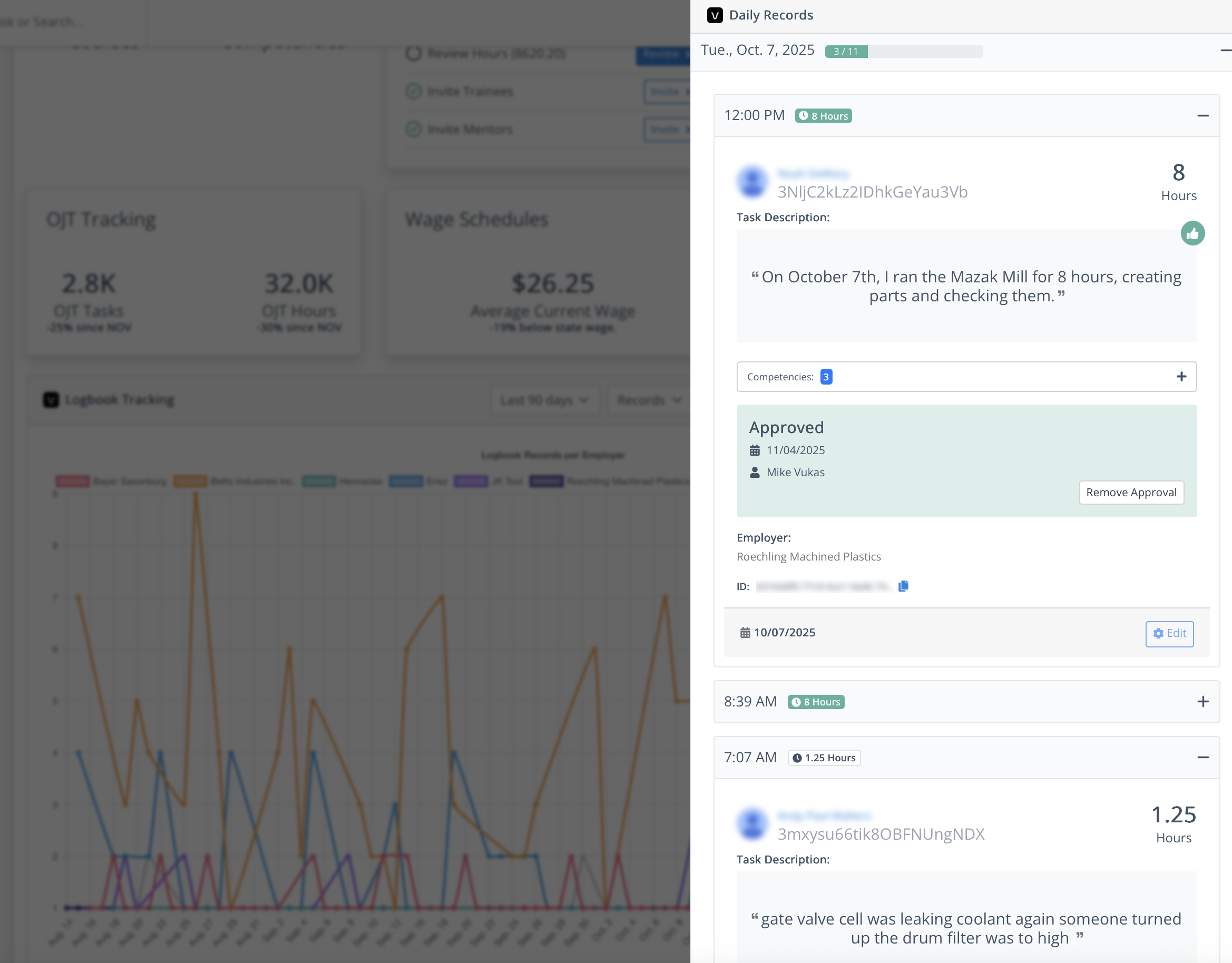
Supervisors receive entries in a review queue. They see the task description, hours, and competency tags. They approve, reject, or request clarification. Their name and timestamp go on the record.
This isn't batch sign-off. Supervisors are reviewing individual records and validating that the work actually happened. That's what DOL means by "supervisor verification."
Supervisor-Validated Work Records: Examples
Sample OJT Record #1 (Sanitized)
"Replaced hydraulic cylinder seal on press #3. Leak was causing 15 psi drop. Tested to 2500 psi, held pressure for 10 min. Returned press to production."
Why this matters: When DOL asks "show me evidence this apprentice completed hydraulic training," you pull this record. It has the task, the hours, the competency mapping, and the supervisor who verified it. No reconstruction needed.
Sample OJT Record #2 (Sanitized)
"Troubleshot PLC fault on conveyor line 2. Found damaged proximity sensor causing false triggers. Replaced sensor, rewired connection, verified signal in ladder logic. Line running at full speed, no faults in 2 hour test."
Why this matters: High-detail entry with specific equipment, diagnostic steps, and outcome. Demonstrates the apprentice is progressing through WPS electrical competencies with verified, task-level evidence.
Verified Results: GACC PIT 2023 → December 2025

GACC PIT is an intermediary sponsor operating state-registered apprenticeship programs in advanced manufacturing across Western Pennsylvania. 143 active apprentices across seven occupation pathways at multiple employer sites.
Operating as an intermediary means coordinating OJT documentation across multiple employers—each with different supervisors, schedules, and work environments.
Before VELA: paper logbooks filled out from memory, supervisor sign-off on batches of records, manual data entry into tracking systems, and audit prep that consumed weeks of staff time every review cycle.
The goal: documentation that satisfies DOL requirements as a natural outcome of daily operations—not a quarterly scramble.
[1] Internal program metrics: OJT record counts, hours, users, approval rate, competency coverage. Data as of December 2025.
Want to see your sponsor's gap dashboard? Book a 15-minute walkthrough.
Schedule Demo →
DOL Review Readiness: Alignment with Standards
Work Process Schedule (WPS) Tracking
Your Standards of Apprenticeship include a detailed Work Process Schedule—the competencies and hour targets for OJT. DOL reviewers expect to see evidence that apprentices are progressing through WPS competencies, not just accumulating hours.
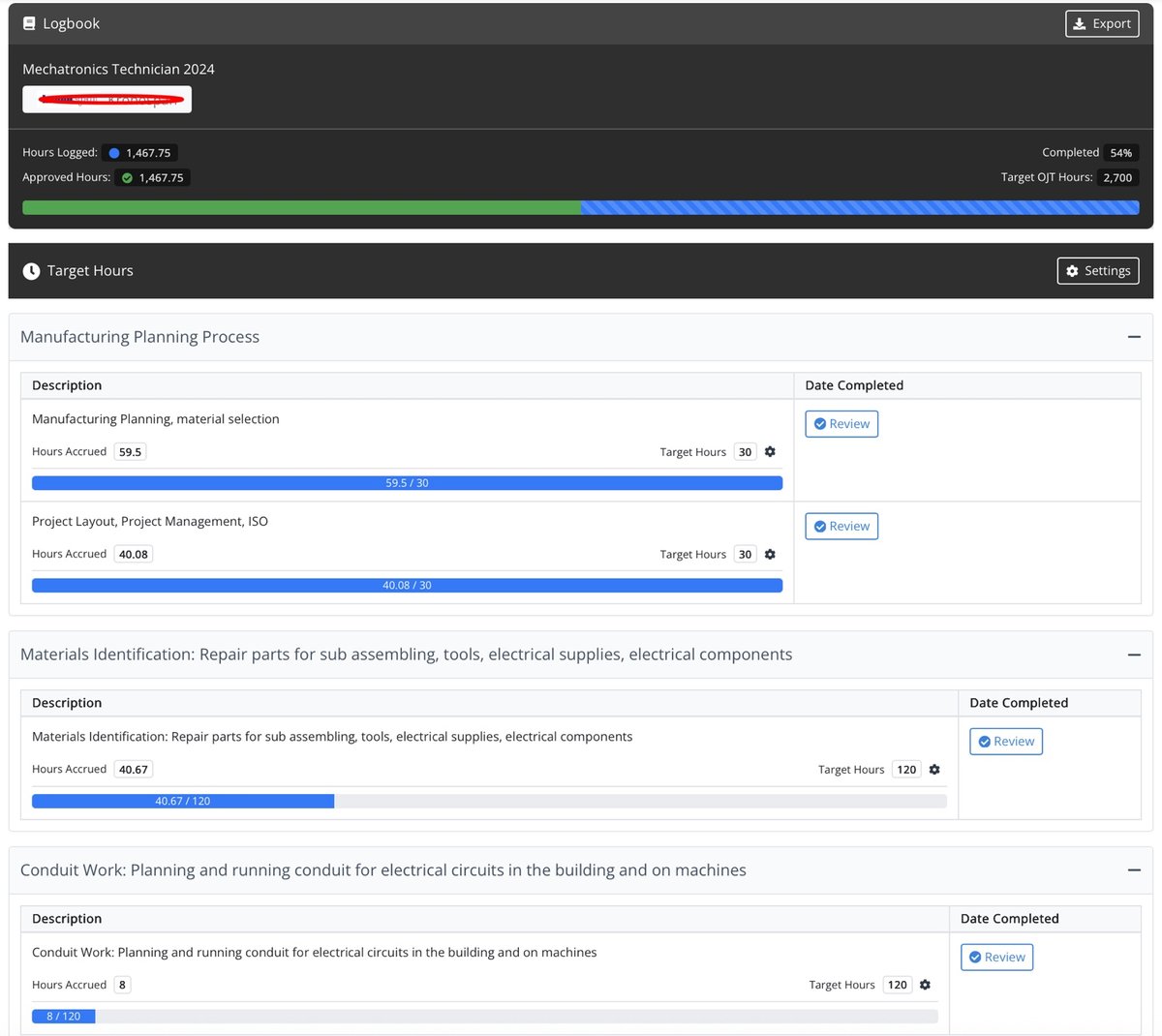
With VELA, every OJT record is automatically mapped to your registered WPS competencies. You can show exactly how many hours an apprentice has documented against "Hydraulic Systems" or "PLC Troubleshooting"—and what specific tasks they performed.
Supervisor Verification
DOL doesn't accept "supervisor signed off on a batch of timesheets" as verification. They want evidence that a supervisor reviewed and validated the work actually happened.
With VELA, supervisors review individual OJT records—seeing the task description, hours, and competency tags. Their approval creates a timestamped record with their name. That's audit-grade evidence of supervisor verification.
Sponsors must maintain records sufficient to demonstrate that apprentices "receive on-the-job training and related instruction in accordance with the work processes set forth in the standards."
In DOL's audit practice and state apprenticeship agency reviews, batch-signed timesheets do not meet this requirement because they fail to prove the apprentice received OJT aligned to specific competencies or that the supervisor personally verified the work performed.
U.S. Department of Labor, Office of Apprenticeship. Title 29 CFR Part 29—Labor Standards for the Registration of Apprenticeship Programs. §29.10(a)(1)(i)–(ii).
Common practice vs. federal standard: Sponsors commonly rely on "batch-signed timesheets" for OJT verification, but this practice fails to meet federal standards for competency-aligned, supervisor-validated documentation.
(See: 29 CFR §29.10; DOL National Apprenticeship System Enhancements NPRM, RIN 1205–AC13, 2023; Abt Associates, ETA OP 2022–05, p. 36.)
RAPIDS Reporting
RAPIDS expects sponsors to report OJT progress accurately. With VELA, you're not estimating hours or reconstructing records at reporting time. You have verified, competency-mapped data that aligns directly with what you registered in your Standards.
How OJT Records Support RAPIDS Reporting & DOL Reviews
| DOL Requirement | How VELA Supports It |
|---|---|
| Work Process Schedule alignment | Every OJT entry auto-tagged to registered WPS competencies |
| Supervisor verification of OJT | Individual record approval with name + timestamp |
| Task-level evidence of training | Narrative descriptions captured at point of work |
| Hours documented by competency | Cumulative hours tracked per WPS category |
| RAPIDS reporting accuracy | Verified data exports without end-of-period reconciliation |
| Audit-ready documentation | Records available on demand—no reconstruction required |
This mapping reflects current DOL Registered Apprenticeship review expectations. Specific requirements may vary by state and registration agency.
Grant Reporting & State Framework Alignment
The OJT evidence VELA captures—task completed, time spent, date, competencies matched, supervisor-validated record—aligns with current sponsor review expectations and grant reporting requirements across multiple frameworks.
DOL Sponsor Review Expectations
DOL reviewers consistently ask sponsors to demonstrate task-level OJT evidence with supervisor verification. The direction toward competency-based documentation—tracking tasks completed, time spent, and competencies attained—reflects where reviewer expectations are heading.
VELA alignment: Semantic task-to-competency capture meets this documentation standard today.
WIOA §116 Performance Accountability[4]
Grantees must demonstrate participants' measurable skill gains and credential attainment based on verified training artifacts—evidence for "participants achieving documented progress toward a credential or employment."
VELA alignment: OJT records serve as compliant evidence for measurable skill gain measures.
H-1B PIRL 2025 Schema & QPR Revisions[5]
Revised Participant Individual Record Layout consolidates training outcomes around competency-based completion events. Data elements like PIRL 1813 (Date Completed Training) depend on time-stamped task completion data.
VELA alignment: Time-and-task capture provides the digital evidence base for revised outcome calculations.
Pennsylvania WIOA 2024–2028 Combined State Plan[6]
Emphasizes career pathways, apprenticeship integration, and data systems that make work-based learning visible and reportable—establishing "unified data and reporting infrastructure for work-based learning."
VELA alignment: Persisted, machine-readable OJT artifacts align with Commonwealth priorities.
This documentation model aligns with current review expectations and positions sponsors well as competency-based documentation, performance accountability, and digital reporting standards evolve at both federal and state levels.
References
Compliance Consistency Across Employer Sites
If you're a single-employer sponsor, you control documentation standards at one site. But if you're an intermediary—or a single employer with multiple locations—you know how hard it is to maintain consistent documentation across supervisors and sites.
Same capture process • Same approval workflow • Same data format
Regardless of how many sites or supervisors—documentation quality stays consistent
With VELA:
- Every site uses the same process. Apprentices capture OJT the same way whether they're at Employer A or Employer B.
- Supervisors have the same expectations. They review the same type of records, with the same information, in the same interface.
- You see documentation gaps before they become findings. Dashboards show which apprentices haven't logged OJT recently, which supervisors are falling behind on approvals, and which competencies have thin evidence.
Administrative Burden Reduction
Program staff aren't spending weeks on audit prep anymore. The documentation exists, structured and verified, as a byproduct of daily operations.
What's reduced:
- Manual data entry from paper logbooks
- Follow-up with supervisors for missing signatures
- Reconciling hours across tracking systems
- Reconstructing records before DOL reviews
- Responding to findings about incomplete documentation
Based on industry benchmarks and program feedback, sponsors running similar portfolios typically see 4–6 FTEs' worth of administrative workload offset—hours previously dispersed across coordinators, supervisors, and admin staff that VELA consolidates into exception handling only. This time can be redirected to program development, employer outreach, and apprentice support.[2]
[2] Administrative workload offset estimate based on process time analysis: pre-VELA OJT record processing (~30 min/record including data entry, validation, approval follow-up) vs. post-VELA exception handling (~5-9 min/record). Applied to ~19,000 records/year yields 8,000-10,000 hours; at 1,800 working hours per FTE = 4.4–5.6 FTEs. These are modeled estimates; actual results vary by organization.
Federal Grant Compliance (for WIOA-funded programs)
If your apprenticeship program receives federal funding (WIOA, H-1B discretionary grants, etc.), you have additional documentation requirements under 2 CFR 200.430(i) (Uniform Guidance).
How VELA supports federal time and effort requirements:
| Requirement | How VELA Addresses It |
|---|---|
| Time + Task Recording | Every OJT entry captures hours worked and specific activities—aligned to cost objectives |
| After-the-Fact Verification | Supervisor approval creates timestamped validation trails |
| Audit-Ready Records | Structured evidence with competency tagging supports 3-year post-closeout retention (2 CFR 200.334) |
| Multiple Funding Source Support | Time distribution records can be allocated across WIOA titles based on actual work performed |
Key federal alignment points:
- ETA-9130 / ETA-9179 reporting: Time and task data aligns with Quarterly Financial and Narrative Report requirements
- PIRL-2025 schema: Documented participant activities support data validation under DOL's Building Pathways Toolkit
- Internal controls: Structured capture and supervisor verification satisfy Uniform Guidance requirements for personnel cost documentation
Administrative Workload Offset Methodology
Assumptions
These are modeled estimates. Actual results vary by organization.
Calculation
Step 1: Baseline labor per record
Before VELA:
- Manual entry and transcription: ~15 min
- Validation and approval follow-up: ~10 min
- Data cleanup for reports: ~5 min
- Total: ~30 min per record
VELA reduces this to exception handling only (~5–9 min), a 70–85% reduction.
Step 2: Hours saved
| Scenario | Hours Saved per Record | Total Hours Saved (19K records) |
|---|---|---|
| Conservative (70% reduction) | 0.35 hr | ~6,650 hr |
| Moderate (80% reduction) | 0.40 hr | ~7,600 hr |
Add ~1,500 hours reduction in report prep → Estimated total: 8,000–10,000 hours annually.
Step 3: Cost equivalent
| Hours | × Rate | = Estimated Offset |
|---|---|---|
| 8,000 hr | $45/hr | ~$360,000 |
| 10,000 hr | $45/hr | ~$450,000 |
At 1,800 working hours per FTE: ~4.4–5.6 FTEs' worth of administrative workload offset.
Note for Apprenticeship Training Organizations (ATOs)
This system focuses exclusively on OJT documentation and supervisor validation—not Related Technical Instruction (RTI) or curriculum delivery. It captures what happens on the job site, not in the classroom.
For ATOs that deliver RTI through an LMS or in-person instruction, VELA operates alongside your existing training delivery platform. Separating OJT evidence from RTI delivery reduces coordination friction: you track instruction completion in your LMS; employers track OJT evidence in VELA. When sponsors or DOL ask for documentation, each system produces its own clean record—no manual reconciliation required.
During sponsor reviews or employer audits, ATOs can demonstrate that OJT documentation aligns with common review expectations independently of how RTI was delivered. This clarity reduces finger-pointing and makes it easier to identify where gaps exist.
Who This Helps
The Bottom Line
Are you an Org decision maker?
We invite you to create an Apprentage Org Free Trial. Activate your team. No credit card required.
Start Your Free Trial →
No credit card • Setup in minutes • Full platform access